
Introduction to Underwater Assembly
Underwater assembly is one of the most demanding disciplines in marine engineering and commercial diving. Operating in the challenging conditions of the Baltic Sea requires meticulous planning, robust engineering, and precise execution. Whether assembling structural components for offshore wind farms, mooring systems for floating platforms, or pipeline connections, every task demands a thorough understanding of subsea hydrodynamics and material behavior. Dronelab has been active in these waters since 2006, executing complex subsea tasks where precision matters most.
The Role of Commercial Divers in Subsea Assembly
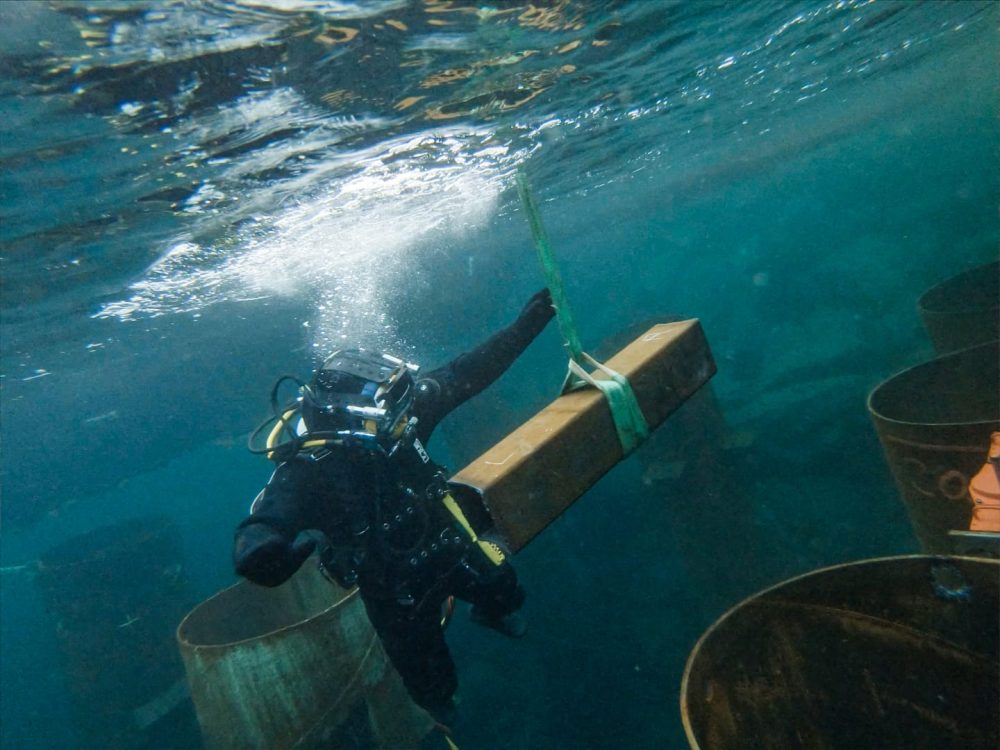
Commercial divers remain fundamental for intricate assembly work that requires manual dexterity and tactile feedback. Surface-supplied diving systems allow technicians to work at considerable depths, utilizing hydraulic and pneumatic tools to bolt, clamp, and fit subsea infrastructure. Divers work closely with support vessels and deck teams to ensure safety protocols are strictly followed. Communication is critical; every movement and torque application must be coordinated with surface supervisors. Despite the increasing capabilities of remote systems, human operators are often irreplaceable when complex, non-standard alignment is required.
Integrating ROVs and USVs in Installation Operations
Remotely Operated Vehicles and Unmanned Surface Vessels have transformed how underwater assembly projects are planned and executed. ROVs provide continuous visual monitoring, high-definition video feeds, and precise manipulation capabilities in environments that may be too hazardous or deep for human divers. Heavy-workclass ROVs can handle large structural components, positioning them with sub-centimeter accuracy using advanced sonar and positioning arrays. Meanwhile, USVs conduct hydrographic surveys and monitor surface conditions during the deployment phase, ensuring that offshore operations proceed safely without unexpected environmental interference.
Key Phases of an Underwater Assembly Project
Every successful subsea assembly project follows a structured lifecycle. Understanding these phases helps project managers mitigate risks and avoid costly delays.
- Pre-Engineering and Survey: High-resolution bathymetric surveys and sonar scans map the seabed to identify hazards and determine exact positioning coordinates.
- Component Preparation: Cleaning mating surfaces, checking seal integrity, and testing hydraulic or mechanical fasteners prior to deployment.
- Deployment and Positioning: Lowering components through the water column using crane vessels, guided by ROV cameras and acoustic positioning.
- Final Securing and Inspection: Torqueing bolts to precise specifications, conducting non-destructive testing, and verifying structural stability.
Tooling and Technology Innovations
The success of underwater assembly heavily relies on specialized tooling designed to withstand high pressure, corrosive saltwater, and low-visibility conditions. Hydraulic torque tools, subsea impact wrenches, and specialized rigging gear are standard equipment for modern marine contractors. Furthermore, advanced hydraulic couplers and mechanical connectors have drastically reduced the time required to join subsea pipelines and cables. These innovations minimize bottom time for divers and reduce overall project duration, thereby lowering operational expenditures for asset owners.
Challenges Specific to the Baltic Sea Environment
Working in the Baltic Sea presents unique obstacles for underwater assembly operations. The brackish water, shifting seabed sediments, and highly variable visibility require specialized equipment and adaptable methodologies. Strong currents and sudden weather changes can interrupt deployment phases, making accurate meteorological and hydrographic forecasting essential. Furthermore, historical wrecks and protected marine habitats demand stringent environmental assessments before any assembly or construction work commences. Compliance with local and international maritime regulations is non-negotiable for all operations.
Quality Assurance and Documentation
Verification is the final and perhaps most crucial step in any subsea assembly operation. Clients require comprehensive documentation to prove that installations meet rigorous engineering standards. This includes digital video logs from ROV inspections, pressure test reports, torque verification logs, and as-built hydrographic surveys. By maintaining transparent quality control measures, operators ensure long-term structural integrity and minimize the risk of catastrophic subsea failures. Experience gained over decades of operating in Northern European waters ensures that safety and precision remain at the forefront of every assignment.