Introduction to Underwater Demolition
Underwater demolition is a complex engineering discipline involving the controlled removal of submerged structures, wrecks, foundations, and geological obstacles. Operating since 2006 in Riga and across the Baltic Sea, Dronelab provides technical expertise and specialized marine services for demanding maritime environments. Executing demolition works beneath the surface presents unique challenges that differ significantly from terrestrial engineering projects. High hydrostatic pressure, zero-visibility water conditions, unpredictable currents, and structural instability require meticulous planning and execution.
Preparation and Preliminary Surveys
Before any explosive or mechanical cutting takes place, comprehensive site investigation is mandatory. Hydrographic surveys, multibeam sonar mapping, and visual inspections using Remotely Operated Vehicles (ROVs) establish the exact condition and geometry of the target structure. Commercial divers often conduct tactile inspections when visibility permits. Engineers must assess the material composition, whether it is reinforced concrete, structural steel, or timber, to determine the appropriate demolition methodology. Environmental impact assessments are equally critical to protect local marine ecosystems, fish populations, and nearby port infrastructure from excessive shockwaves and debris dispersion.
Methodologies: Explosive vs Non-Explosive Demolition
Choosing the correct technique depends entirely on the project scope, depth, and proximity to operational assets. The two primary approaches utilized in marine construction are explosive demolition and mechanical dismantling.
- Explosive Demolition: Highly efficient for large-scale removals such as bridge piers, massive concrete caissons, and sunken shipwrecks. It relies on shaped charges placed precisely by commercial divers or specialized manipulators on ROVs to fracture material along calculated stress lines.
- Mechanical Demolition: Utilizes hydraulic shears, diamond wire saws, high-pressure water jets, and heavy-duty underwater thermal cutting torches. This method is preferred when working near active shipping lanes, underwater pipelines, or sensitive environmental zones where blast vibrations must be strictly avoided.
The Role of Commercial Divers and ROVs
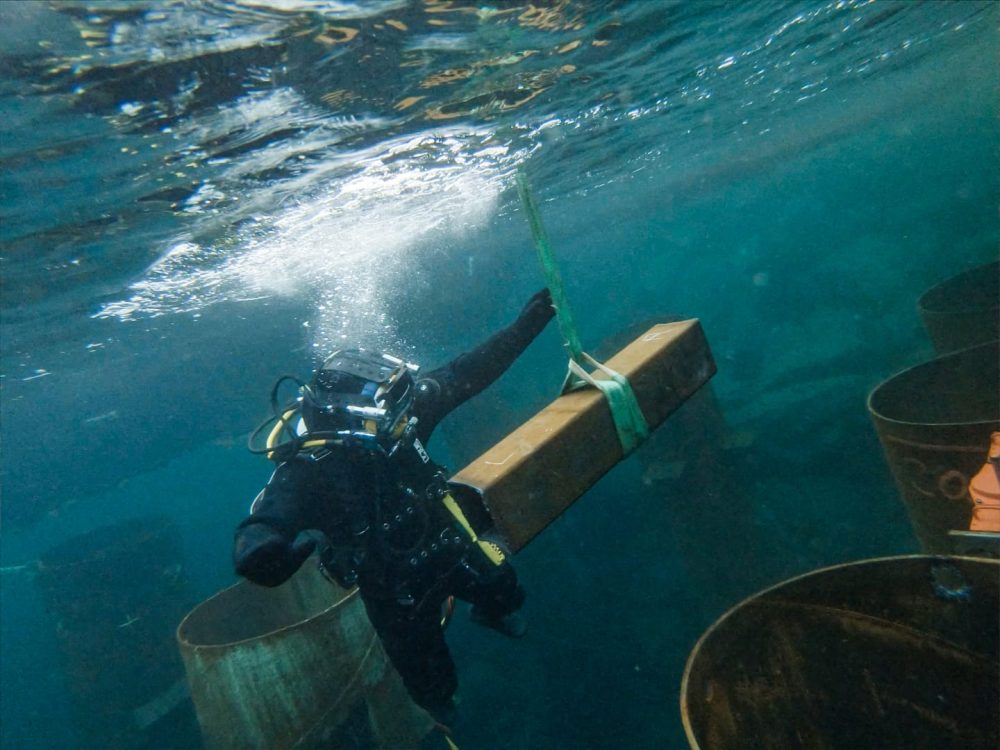
The success of any underwater demolition project heavily relies on the synergy between human expertise and robotic technology. Commercial divers bring unmatched dexterity and problem-solving capabilities to the underwater workspace. They place demolition charges, rig heavy lifting gear, and perform delicate pre-cut preparations in tight spaces where machinery cannot reach. Conversely, ROVs provide critical operational safety and efficiency by monitoring the site in real time, clearing initial debris, and operating in hazardous zones that exceed human dive limits regarding depth or current velocity. Surface-supplied diving spreads ensure continuous breathing gas supply and reliable communications, minimizing physiological risks associated with deep subsea operations.
Safety Protocols and Environmental Compliance
Safety is the absolute priority in marine demolition projects. Strict adherence to international commercial diving standards, maritime laws, and local port regulations prevents accidents and structural failures. Before detonation or heavy mechanical extraction begins, clear safety perimeters are established using surface support vessels and acoustic monitoring systems. Marine mammals and fish are deterred using non-lethal acoustic harassment devices when applicable. Waste management following demolition is another vital phase. Submerged debris, scrap metal, and hazardous materials must be recovered efficiently using crane vessels to restore the seabed to its original navigational status, preventing long-term hazards to commercial shipping and commercial fishing fleets.
Execution and Post-Demolition Verification
The final phase of any underwater demolition project is verification and clearance surveying. Once the cutting or blasting is completed, hydrographic teams deploy side-scan sonar and drop cameras to inspect the seabed. This ensures that no hazardous remnants protrude above the required clearance depth for navigation channels. Dronelab continues to support maritime infrastructure projects throughout the Baltic region by delivering accurate, factual, and engineering-driven underwater solutions tailored to the rigorous demands of modern ports and offshore installations.